models
WEN JT630H: Specs, Fit & Buying Guide
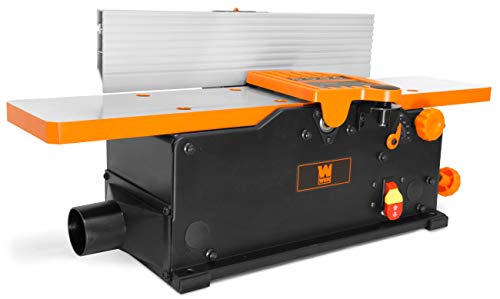
The WEN JT630H is the six-inch, 12-HSS-insert choice in WEN’s current benchtop jointer family. It keeps the same nominal cutting width and compact base-table class as the two-knife JT3062, while the JT833H and JT1224H move to wider stock and different support arrangements. This guide separates those documented differences without claiming a finish winner or hands-on test.
As an Amazon Associate I earn from qualifying purchases. “Check Amazon” links are affiliate links.
Inspect the exact model offer
Check exact model, included equipment and current seller details.
Check AmazonWhat this model offers
The JT630H pairs a six-inch cutting width with a 30 by 6-3/16-inch table and a spiral arrangement of 12 HSS inserts. Its manual specifies 120V, 60 Hz, 10A power, a 2-1/2-inch dust port and 36.8-pound machine weight. WEN identifies BP510H replacement blades for this model. HSS is a specific cutting material; separate inserts do not make the supplied edges carbide.
WEN’s current product copy says the cutterhead reaches 12,000 RPM, while the linked January 2024 manual’s specification table says 11,000 RPM for both JT630H and JT833H. This guide does not resolve that revision conflict by assumption. Confirm the nameplate and current manual if cutterhead speed affects a purchase or service decision. The November 2025 family manual also lists 11,000 RPM, so the newer document does not resolve the product-page discrepancy.
Build the decision around your projects
For a maker building small boxes, drawer components or modest furniture parts, the useful question is how much stock arrives wider than the machine. Write down the rough widths for the next three projects. If almost everything is comfortably within six inches, a wider machine may have little immediate value. If the attractive boards at your lumber supplier regularly exceed that width, the apparent space saving may create a recurring preparation problem. Keep rough-size requirements distinct from the smaller finished dimensions on a drawing.
Compare the right alternatives
Start with the JT3062 when six-inch capacity is enough but you prefer its two full-width SK5 knives and their adjustment routine. Stay with the JT630H branch when the same nominal width works and individual BP510H HSS cutters are the preferred service path. Move to the JT833H only when recurring rough faces exceed six inches or its 33-inch base and 51-inch extended support span solve a documented setup need.
The JT1224H is a separate twelve-inch, cast-iron-table installation: its manual lists 87.1 pounds, 24 HSS cutters and a 54-inch extended span. That is not a direct feature upgrade for every small shop. A larger cutterhead is worth considering only when it removes a recurring stock-width limitation and the complete station still fits.
- JT3062: 6-inch cut, two full-width SK5 knives, 30-inch table, 2-1/2-inch port
- JT630H: 6-inch cut, 12 BP510H HSS cutters, 30-inch table, 2-1/2-inch port
- JT833H: 8-inch cut, 16 BP510H HSS cutters, 33-inch base table, 51-inch extended span, 2-1/2- and 4-inch ports
- JT1224H: 12-inch cut, 24 BP510H HSS cutters, 34-inch cast-iron base table, 54-inch extended span, 2-1/2- and 4-inch ports
Check the complete product offer
Affiliate link. Confirm the version, specifications and included accessories before purchase.
Check AmazonFitting the JT630H into a shared workshop
The 30-inch table makes the JT630H a compact station, but the board still needs a clear approach and exit beyond it. Lay out the path using the rough stock from your project list, including room for your stance and the 2-1/2-inch dust hose. Six-inch capacity answers a face-width question; it says nothing about the longest board you can control. Multiplying the table length by a rule of thumb cannot establish that limit.
At the manual’s 36.8-pound weight, storage and mounting deserve separate decisions. A shelf location is useful only if you can transfer the machine safely to a stable, clear bench when needed. For a cart installation, check the operating position as well as the parked footprint. Keep the controls reachable and the hose away from incoming lumber, then plan where the prepared pieces will wait for thicknessing.
Ownership and replacement parts
The replacement-blade reference is a useful starting point for estimating upkeep. Check the number of pieces in a replacement package and retain the manual’s installation instructions rather than choosing an insert by its photograph. Plan a place for adjustment tools so they do not end up on the table. Before diagnosing a poor glue joint as a blade problem, distinguish a rough surface from an edge that is not square; they are different symptoms and can lead to very different purchases.
Checks before you order
WEN’s linked manual covers JT630H and JT833H. The published minimum stock limits are 8-1/8 inches long, 3/4 inch wide and 1/4 inch thick, with a listed maximum cut of 1/8 inch and a recommended cut of 1/32 inch. These are boundaries, not a recommendation for small-stock work or a default cut for every board.
Before accepting delivery, match the JT630H label, fence and guard to the saved order and manual. Establish the seller’s process for missing components or shipping damage while return options are clear. Compare the full station cost with the JT3062: include BP510H cutting edges, extraction, mounting and measuring tools, rather than treating the machine-price difference as the whole ownership difference.
Questions, answered
Is the WEN JT630H a thickness planer?
No. The JT630H prepares a flat reference face and a square reference edge. A thickness planer is still needed for the separate job of making the opposite face parallel at a chosen thickness; the spiral cutter arrangement does not add that function.
Can I use the full 6-inch width on any board?
Only if the board and operation also meet the JT630H manual. Its six-inch nominal width does not override the documented minimum stock dimensions, cut-depth limits, grain considerations or the need to control the workpiece.
What should I verify in a WEN JT630H listing?
Match JT630H on the order and machine label; check the BP510H HSS cutter specification, fence, guard, 2-1/2-inch dust connection and seller terms. Retain the matching manual and resolve its cutterhead-speed discrepancy with the current product page before relying on RPM.