buying guides
What Stand or Workbench Does a Benchtop Jointer Need?
A benchtop jointer needs a stable station that supports the actual machine, its mounting arrangement and the way boards move through the shop. A cart advertised as universal is only a candidate until those details agree. Start by planning the complete workstation, then compare a fixed bench, dedicated stand or mobile base against that plan.
As an Amazon Associate I earn from qualifying purchases. “Check Amazon” links are affiliate links.
A relevant product to inspect
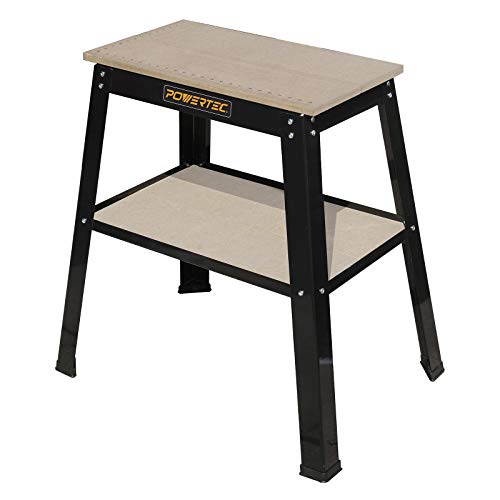
Check exact model, included equipment and current seller details.
Check AmazonIs the advertised weight capacity enough?
Capacity is necessary but does not prove suitability. Record the machine’s operating weight, accessories and anything stored on the station. Then check how the stand manufacturer defines its rating. A load spread across a work surface is not automatically equivalent to a concentrated machine load or the forces applied during feeding.
Compare the platform dimensions and machine footprint separately. A strong stand with a small top can still be a poor match. Avoid assuming that a large published weight number answers questions about tipping, racking or secure mounting; those require attention to the actual setup.
How should you verify mounting compatibility?
Use the jointer’s mounting instructions and measure the approved hole pattern. Compare it with the stand’s supplied brackets, slots and fasteners. Check that the dust outlet, adjustment handles, ventilation and power switch remain accessible after mounting. A photograph that looks close is not a fit confirmation.
If a manufacturer-approved mounting board is part of the installation, follow its material, fastening and attachment requirements. Do not improvise a thin adapter panel simply because it bridges the holes. Keep the mounting plan documented so moving the machine later does not depend on remembering which hardware was used.
Should you use a fixed bench or mobile cart?
A fixed bench can suit a shop where the jointer has a permanent working lane and the bench is appropriate for the machine. A mobile station can suit shared space, but mobility adds another setup step each time you work. Compare the time needed to position, secure and reconnect the machine with how frequently you expect to use it.
Before buying a mobile base, verify the supported footprint and the method that makes it stationary for operation. Locking arrangements differ. BORA’s documented base examples show that capacity, adjustment range and locking mechanisms are separate specifications. Their existence does not certify a particular base for your jointer.
Check the complete product offer
Affiliate link. Confirm the version, specifications and included accessories before purchase.
Check AmazonHow much space should surround the station?
Plan the path of the longest permitted board on both sides of the cutterhead, together with room for your stance and any approved supports. Include the hose bend and power-cord route. A station can fit against a wall while still failing as a usable jointing area because the board cannot enter or leave cleanly.
Mark the proposed station and stock path on the floor before ordering. Check doors, stored lumber, nearby machines and walking routes. Treat this as a layout exercise with the machine disconnected, not a live trial of an uncertain arrangement. Working height also deserves attention because the jointer body adds height above the stand top.
What should you check after moving or assembling it?
Confirm that the station does not rock, that mounting hardware is secure and that the manufacturer’s operating support or locking system is engaged. Make sure the floor is suitable and the hose cannot pull the machine or create a trip hazard. The Cutech 40180H series manual specifically calls for correcting an unstable installation before use.
Recheck access to the switch and controls with the machine fully arranged. If securing the cart still leaves unacceptable movement, stop using that arrangement and choose a suitable station. Saving floor space is useful only when the resulting workstation supports controlled operation.
Questions, answered
Will any universal stand fit?
No. Confirm the mounting pattern, dimensions, load requirements and installation instructions for both products.
Can I use a folding workbench?
Only if its manufacturer supports the intended machine installation and all mounting and stability requirements are met. A capacity label alone is insufficient.
Do locking casters guarantee stability?
No. Evaluate the complete stationary support arrangement and follow the base instructions. Do not operate a station that moves or rocks.

