models
Wahuda 50180CC-WHD: 8-Inch Width & 51-Inch Support
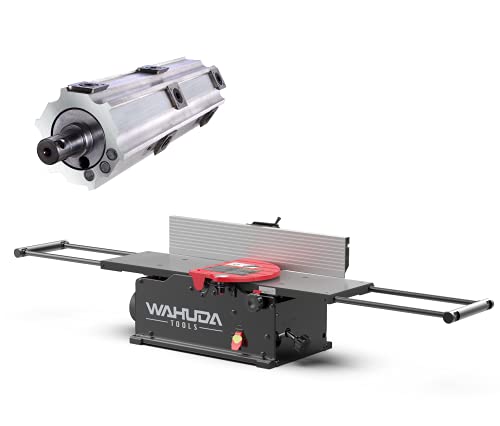
The Wahuda 50180CC-WHD is the middle family choice when six-inch capacity is too restrictive but ten inches is unnecessary. Its manual lists an eight-inch head, 16 four-sided carbide inserts, a 33.5-inch base table and 51-inch adjusted support span. The product narrative rounds the base to 34 inches, and 115/120V wording conflicts, so the formal table dimensions and delivered nameplate deserve priority.
As an Amazon Associate I earn from qualifying purchases. “Check Amazon” links are affiliate links.
Inspect the exact model offer
Check exact model, included equipment and current seller details.
Check AmazonWhat this model offers
Wahuda identifies the 50180CC-WHD as its eight-inch spiral-style machine with cast iron tables, 16 four-sided carbide inserts and a 64-pound net weight. The manual’s specification table gives a 33.5-inch base and 51-inch extended support, while the product narrative rounds the base to 34 inches. Use 33.5 inches for fitted-layout planning and confirm the delivered configuration; extended support is not a maximum allowable stock length.
Build the decision around your projects
A buyer making side tables, cabinets or similar furniture can begin by reviewing rough-stock widths across several projects. If many boards exceed six inches but stay within eight, this class may reduce recurring capacity compromises. If most work uses prepared narrow stock, that same extra capacity may sit unused. Make the decision using the incoming board size, not only the finished component width. Planning the material route also helps reveal whether a separate thickness planer remains the next constraint.
Compare the right alternatives
Within Wahuda’s family, the six-inch 50160 has a fixed 30-inch table and 12 inserts; this 50180 has 33.5 inches of base table, 51 inches of support and 16 inserts; the ten-inch 50110 adds two inches of capacity, 20 inserts and a 12A motor. Choose this middle model when boards repeatedly exceed six inches but do not justify the ten-inch head and heavier setup. The WEN JT833H and Cutech 40180HI remain separate exact-model comparisons; nominal width does not make their inserts interchangeable.
Check the complete product offer
Affiliate link. Confirm the version, specifications and included accessories before purchase.
Check AmazonWorking room beyond the extension arms
The 50180CC-WHD’s extension arms bring the published support span to 51 inches, not the length of a continuous solid table. Lay out the manual’s 33.5-inch base and the extended arrangement, then check the travel of the rough boards you intend to prepare. Face width up to the stated eight inches does not establish a safe maximum length. Your stance, approach, exit and any separate support all consume space beyond the machine.
A shared bench needs to be available when milling begins, not merely large enough after every other tool is removed. Decide how the cast iron machine will be mounted and moved, and keep the controls and hose accessible in its working position. On a cart, draw both parked and operating layouts. Resolve the electrical specification before treating a nearby receptacle as a completed installation plan.
Ownership and replacement parts
Cast iron working surfaces are worth considering alongside the building where the tool will live. A dry enclosed shop and a damp shed impose different storage needs. Keep a reliable straightedge and square available for setup checks, and allow time to inspect the delivered assembly before a project deadline. Build a small parts record with the full model number and approved consumables. That record will be more useful than saving a generic search result for eight-inch jointer blades.
Checks before you order
The matching manual warns against stock shorter than 10 inches, narrower than 3/4 inch or thinner than 1/2 inch, and lists 1/8 inch as the maximum depth of cut. Its specification table says 120V while its grounding text and the product table say 115V, so voltage remains unresolved and the nameplate governs installation.
Ask for the current matching instructions and the exact delivered equipment before committing to this model. Inspect the extensions, fence, guard and extraction fittings against the order and retain the seller’s damage, missing-part and return procedures. Include approved four-sided cutters, measuring tools, a mounting arrangement and collection in the comparison budget, rather than pricing the wider cutterhead alone.
Questions, answered
Is the Wahuda 50180CC-WHD a thickness planer?
No. The 50180CC-WHD supplies the reference-face and edge steps in milling. A separate thicknessing operation must make the opposite face parallel; eight-inch jointer width does not guarantee the rest of your equipment can accept the same boards.
Can I use the full 8-inch width on any board?
Width alone is insufficient. The manual warns against stock under 10 inches long, 3/4 inch wide or 1/2 inch thick; grain, condition and controllability also matter. The 51-inch support measurement is not an approved board-length limit.
What should I verify in a Wahuda 50180CC-WHD listing?
Identify the 50180CC-WHD and its 16 four-sided carbide inserts, then check extension equipment, fence, guard and both the four-inch outlet and 2-1/2-inch adapter. Confirm nameplate voltage because official materials conflict, and retain the seller’s terms.