comparisons
Benchtop vs Floor-Standing Jointer: What Matters?
A benchtop jointer makes sense when compact storage and the machine’s documented stock envelope fit your work. A floor-standing machine deserves attention when a longer reference bed, a permanent station and the surrounding stock path solve problems that cutter width alone does not. Neither category guarantees accuracy. Compare the complete installation and milling sequence, not just the footprint shown in a listing.
As an Amazon Associate I earn from qualifying purchases. “Check Amazon” links are affiliate links.
Two different machine categories to investigate: WEN JT630H is the benchtop example; JET JJ-6HHDX is the long-bed floor-standing listing. These offers are not a tested head-to-head verdict. Check each machine's own manual, installation needs and seller package; a stand alone is not a floor-standing jointer.
A relevant product to inspect
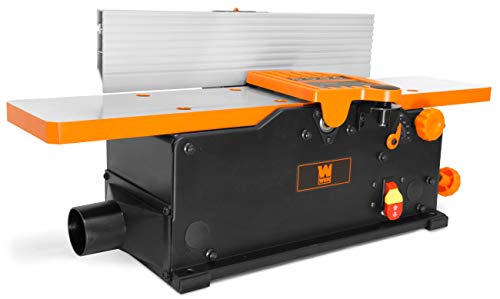
Check exact model, included equipment and current seller details.
Check AmazonSeparate cutter width from reference length
A wide benchtop cutter and a long floor-machine bed address different constraints. Width determines which board face can be presented across the cutter within its limit; table length changes the built-in reference and support available before and after the cutterhead. One dimension does not substitute for the other.
The retained examples make that tradeoff concrete. WEN documents the six-inch JT630H with a compact 30-inch table. JET lists the six-inch JJ-6HHDX with a 56-inch table, including 28-inch infeed and 23-inch outfeed sections. Both are six-inch machines, yet they require very different installations. Long, narrow rails may make the JET layout more relevant; shorter parts that fit the WEN envelope may make the compact station more useful. These specifications are decision inputs, not a measured accuracy contest.
Count working space, not just storage space
Draw both installations at scale and include your longest representative workpiece at entry and exit. Add room for the operator, controls and dust hose. A compact 30-inch table still needs a clear board path; storing the jointer on a shelf does not shorten the stock during use.
Also record what supports the machine. A benchtop jointer needs the manufacturer-approved mounting arrangement and may permanently occupy valuable bench space. A floor machine needs its assembled footprint, delivery route and any permitted base planned before arrival. Do not assume a rolling cart or mobile base is suitable merely because the machine physically fits on it.
Portability has an installation cost
If a machine moves between sessions, include the effort of lifting, securing it and confirming its setup. Repeated handling can be inconvenient even when the machine is technically portable. Consider a dedicated station if that allows it to stay ready without blocking another important task.
Use designated lifting methods, protect adjustment components and secure the base as directed. JET’s December 2025 manual describes the JJ-6HHDX as separate bed and stand assemblies and says the jointer must be firmly secured to the floor or bench. That is a different setup routine from storing and remounting a compact benchtop machine. Do not assume that a lightweight table or rolling cart is acceptable merely because the jointer fits on it.
Check the complete product offer
Affiliate link. Confirm the version, specifications and included accessories before purchase.
Check AmazonEvaluate the full milling workflow
Map one real batch through four stations: establish a usable face on the jointer or another controlled reference method; create an edge related to that face; thickness the opposite face parallel; then size the remaining edge from the prepared references. Place the jointer so the marked reference face and edge can move to the planer and saw without an awkward reset or blocked aisle.
The long-bed JET example lists a 4-inch dust port, 350 CFM requirement and 115/230-volt single-phase motor; the WEN JT630H record uses a 2-1/2-inch port and 120-volt circuit. Those exact-model differences affect hose routing and electrical planning. Apply each candidate’s current manual rather than transferring either setup to another machine.
Compare costs that the price tag omits
A larger machine can require delivery arrangements, a base or electrical work appropriate to its actual specification. A compact machine can require a stand, suitable collection and mounting supplies. Neither should be budgeted as a bare box.
Check replacement cutters, belt and guard availability for the exact model. The JT630H page identifies a 12-cutter HSS system and BP510H replacements; the JJ-6HHDX manual lists 27 four-sided inserts. Those are ownership and service differences, not proof of a finish or durability winner and not a basis for cross-model compatibility. Used floor-standing equipment may offer appealing capacity, but a repair project needs a separate budget.
A practical shortlist method
List the rough-board width, length and condition for three representative projects. Then identify the first real constraint: face width, built-in reference length, documented minimum stock, mounting, extraction, electrical supply or the clear path between machines. Eliminate candidates that fail any required step instead of averaging unlike advantages into one score.
Choose the benchtop route when the documented envelope fits and the compact station genuinely improves shop flow. Move a long-bed floor model higher when recurring long, narrow stock and a permanent installation justify it. If neither machine resolves the entire sequence, price outside preparation or a different workflow before buying. The category comparison is a shortlist method, not a claim that heavier always means better.
Questions, answered
Can a benchtop jointer make accurate work?
It can be suitable when properly set up and used within its limitations. The category alone does not provide an accuracy guarantee or a measured comparison with another machine.
Is an eight-inch benchtop better than a six-inch floor model?
It depends on whether face width or the overall support and working arrangement is the real constraint. Compare both dimensions against your normal parts.
Will a mobile base solve a small shop?
Only if the particular machine can be safely installed that way and there remains adequate working clearance. A stored footprint is not the full operating space.
