comparisons
Jointer vs Planer: Which Should You Buy First?
A jointer establishes a usable face and an edge related to that face. A thickness planer brings the opposite face parallel while approaching the required thickness. Those are consecutive jobs, not competing ways to do the same thing. Buy the machine that fills the first missing stage in the lumber workflow you actually use.
As an Amazon Associate I earn from qualifying purchases. “Check Amazon” links are affiliate links.
A relevant product to inspect
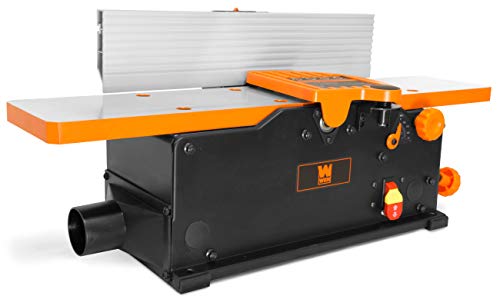
Check exact model, included equipment and current seller details.
Check AmazonMap the four-stage milling sequence
For rough stock, plan four separate results: establish one usable face; prepare one edge in relation to that face; thickness the opposite face parallel; then rip or otherwise size the remaining edge from the prepared references. The exact machines and methods can vary, but every stage needs a controlled reference and must stay within its own instructions.
Mark the prepared face and edge before moving the board. The planer bed receives the reference face so the cutter can work the opposite face; the later sizing operation registers from the prepared geometry. If a stage cannot accept the board’s width, length, thickness or condition, the workflow stops there even when the preceding machine has spare capacity.
What thicknessing adds
Once there is an appropriate reference face, the planer can make the other face parallel while approaching a target thickness. A jointer alone does not establish that parallel relationship: turning the board over and removing material from both faces can follow the existing error rather than create uniform thickness.
This is why the machines are complementary even though both remove wood. Some jointer manuals call a face-jointing pass surfacing or planing; that wording still does not create an opposite parallel face. The useful question is which geometric result is missing before joinery, assembly and final surface preparation.
Start with the lumber you purchase
If you buy stock with a usable flat face but need many pieces at matching thickness, a planer may address your immediate problem. If you already have thicknessing capability but routinely struggle to establish a flat reference and a square edge, a jointer may be the missing station.
If your supplier can prepare the lumber you need at a reasonable charge, you may not need to buy either immediately. Compare that service with the quantity of rough stock you realistically expect to mill over the next year.
Check the complete product offer
Affiliate link. Confirm the version, specifications and included accessories before purchase.
Check AmazonCheck capacity from start to finish
The width on a benchtop jointer and the width on a thickness planer are separate limits. Record rough width, rough thickness, length and stock condition at every stage, along with each machine’s minimum stock and removal restrictions. A desired finished width is useful only when the board can pass through the complete sequence.
A wide planer does not create a reference face on a broad twisted board by default. A wide jointer does not solve a later planer bottleneck. Likewise, a table saw that can rip the final edge does not flatten the face used to register the cut. Build the process map before paying for the largest isolated number.
Be careful with alternatives and jigs
There are alternative reference-preparation methods, including hand tools and purpose-designed fixtures, but they require a suitable procedure and workholding. A casual description of a planer sled should not be treated as complete operating instruction. Do not improvise around guards or minimum stock rules.
When comparing the purchase with an alternative, include the learning, setup and checking time that method requires. A method you can carry out accurately and consistently may be a good interim solution; a shortcut you cannot control is not a useful saving.
Choose the first purchase from the missing stage
Buy the planer first when your stock already has a reliable reference face and repeated thickness matching is the unresolved job. Buy the jointer first when suitable stock fits its limits, thicknessing is already covered and creating a trustworthy face or edge is the recurring failure. If a supplier prepares the stock or a documented alternative method covers the occasional batch, delaying either purchase can be rational.
For small shops, a documented combination machine can cover both stages, but evaluate jointing limits, planing limits and changeover separately. It is not enough for a listing to contain both tool names. The linked JET combo manuals show distinct operating arrangements, while the table-saw comparison explains why final-width ripping still does not replace face preparation.
Questions, answered
Can a planer replace a jointer?
It does not perform the same reference-preparation function by default. Suitable alternative fixtures or methods need their own complete procedure; simply feeding a distorted board is not an equivalent workflow.
Can I make both faces parallel with only a jointer?
A jointer does not automatically establish parallel thickness. Plan a thicknessing operation or another controlled method rather than assuming repeated passes create that relationship.
Which should a beginner buy first?
Choose the machine that fixes the missing step in the lumber you actually use. Surfaced stock, rough stock and existing tools can lead to different sensible answers.