guides
Face Jointing vs Edge Jointing: What Changes?
Face jointing prepares a broad reference surface; edge jointing prepares a long narrow surface in relation to that reference. The distinction matters because a straight edge is not necessarily square to a twisted face. Plan the two operations as connected steps rather than interchangeable cleanup passes.
As an Amazon Associate I earn from qualifying purchases. “Check Amazon” links are affiliate links.
A relevant product to inspect
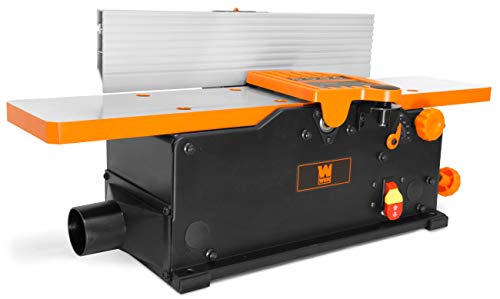
Check exact model, included equipment and current seller details.
Check AmazonName the reference before you cut
Mark the first reference face and its adjacent reference edge, using the same convention throughout the project. The face mark identifies the surface that will register during edge jointing and later sizing; the edge mark preserves the second reference. Carry both through the planer, saw and assembly stages. An accidental flip can waste an otherwise accurate preparation, even on an expensive machine. The full jointing workflow follows those marks from rough blank to the remaining operations.
Face jointing answers a flatness question
The relevant question is whether the broad surface can provide a stable, sufficiently flat reference for the next process. A surface that feels smooth may still be bowed or twisted. Inspect with appropriate measuring tools away from the machine and consider the project's tolerance. Do not keep removing wood just to make the entire surface visually uniform when the blank no longer contains the required thickness. Decide what the next operation actually needs before starting.
Edge jointing answers a relationship question
For a conventional square edge, the prepared face registers against a correctly set fence. The result should be evaluated both for straightness along its length and for the angle to the reference face. Those are different checks. An edge can be straight but tilted, or square locally but curved along its length. When diagnosing a glue-up gap, examine both possibilities rather than treating every poor fit as a fence-angle problem.
Check the complete product offer
Affiliate link. Confirm the version, specifications and included accessories before purchase.
Check AmazonThe operating instructions differ
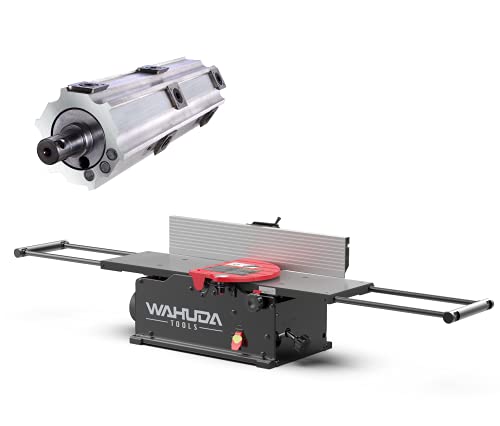
Follow the manufacturer's illustrated procedures for each operation, including guarding, push blocks, stock limits and feed direction. The Wahuda 50180CC manual presents surfacing and edge jointing separately. That organization reflects meaningful differences in orientation and control. A brief article cannot supply every hand movement for every board. If the operation is unfamiliar, obtain competent instruction with your machine and suitable stock before attempting it independently. Keep adjustments and inspection separate from powered cutting.
Preserve the references through sizing
Once the first face and edge are established, decide which later operation produces the opposite face and edge. Record the target dimensions and allowance so you know when to stop. Parallel thickness and final width require their own controlled setup. Jointing every surface repeatedly is not a substitute for planning those relationships. The same approach helps when several parts must match: compare the references and dimensions as a set before proceeding to irreversible joinery.
Inspect a trial joint intelligently
Lay suitable prepared pieces together off the machine and assess the gap without forcing them into place. Note whether the issue changes when a part is reoriented, and use independent straightness and squareness checks to interpret it. Do not assume clamping pressure should correct any mismatch. If a repeated defect appears, document its location and consult the relevant troubleshooting guide. A clear description of the geometry gives you a much better starting point than saying the jointer cuts badly.
Questions, answered
Can I edge joint before face jointing?
Only if you already have an appropriate reference face for the intended operation. A distorted face can undermine the relationship you are trying to establish at the fence.
Does a square fence guarantee a square edge?
No. The reference face, workpiece control and actual result still matter. Check the edge at several locations after cutting rather than relying solely on the setup scale.
Is surface planing another name for face jointing?
Some jointer manuals use that terminology. Do not confuse it with thickness planing, which has a different purpose and machine arrangement.