guides
Can You Joint End Grain, Plywood or MDF?
Do not use a benchtop jointer for end-grain cuts on the strength of an online demonstration. Plywood and MDF also should not be treated as automatically approved because they are sold in the lumber aisle. Match the material and operation to the exact machine instructions before choosing a preparation method.
As an Amazon Associate I earn from qualifying purchases. “Check Amazon” links are affiliate links.
A relevant product to inspect
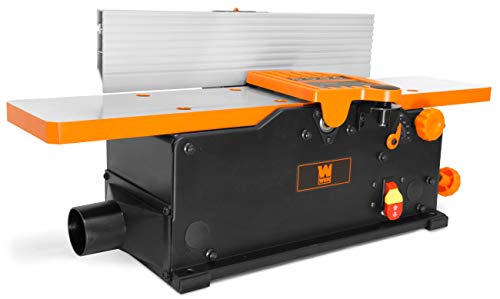
Check exact model, included equipment and current seller details.
Check AmazonEnd grain is a different operation
A board's end presents a different fiber orientation from its long edge. Turning a board sideways is not simply another version of ordinary edge jointing. WEN's JT630H/JT833H manual explicitly warns against feeding against end grain because the workpiece can split and shatter. Keep that warning separate from discussions of reversing the longitudinal grain direction. A technique for orienting a long edge does not authorize machining the end of the board.
Plywood is not a uniform solid-wood board
Plywood contains layers with different grain orientations, adhesives and potentially hidden defects. A surface that resembles wood does not establish that a particular jointer is designed for it. Read the approved-material section and ask the manufacturer when it is unclear. Do not infer approval from the width capacity, motor rating or cutter material. Those specifications answer other questions. The fact that a machine can physically contact a panel edge does not establish an appropriate operation.
MDF raises a separate material question
MDF is manufactured fiberboard rather than ordinary solid lumber. Before machining it, consider the tool's permitted materials, extraction requirements and the intended edge quality. A clean-looking test cut is not proof of an acceptable setup. If the jointer manual does not authorize the material, select a preparation process that does and follow that tool's instructions. Avoid replacing a material-compatibility decision with a guess that carbide cutters should be able to handle anything wood-based.
Check the complete product offer
Affiliate link. Confirm the version, specifications and included accessories before purchase.
Check AmazonIdentify the result you actually need
Perhaps you need a square panel end, a straight sheet edge, a flush laminate or a smooth exposed surface. These are different tasks and may call for different tools. Write down the required result and the available reference surfaces before selecting a method. A saw, router setup, sanding process or hand-tool approach may be relevant, but each requires suitable workholding, capacity and instructions. This guide does not prescribe one substitute operation for every panel or end-grain project.
Treat cutting boards with particular care
An assembled cutting board can combine short components, adhesive joints and changing grain directions. Calling it a board does not make it equivalent to a long piece of solid lumber. Inspect the construction and identify the actual surface you intend to machine. Do not feed an end-grain assembly over a jointer based on claims that a shallow cut makes it acceptable. Seek a suitable flattening or finishing method whose instructions explicitly match the construction and dimensions.
Verify before buying accessories
Before buying a cutter upgrade or push block for a panel project, establish that the machine permits the material and operation. A new insert grade cannot supply missing approval, and extra support does not change an end-grain prohibition. The push-block guide explains the accessory's role within existing guarding and stock limits. If the manufacturer supplies application guidance, retain its exact model, material and operation details with your notes; advice about one setup should not become permission for another.
Questions, answered
Can I joint the end of a board?
Do not treat end-grain jointing as an ordinary edge operation. The WEN manual cited here explicitly warns against feeding against end grain; use a suitable alternative process for the intended result.
Is MDF acceptable if I have carbide inserts?
Carbide alone does not establish material approval. Check the exact machine instructions and choose a different process if the material is not permitted.
Can I flatten an end-grain cutting board on this machine?
Do not infer approval from its size or an online demonstration. Select a flattening method appropriate to the assembly, following the relevant equipment instructions.