guides
Can a Benchtop Jointer Flatten Warped Boards?
A benchtop jointer can help establish a flat reference on suitable warped lumber, but it cannot restore material that flattening removes. Begin by identifying the distortion and estimating whether the finished part still fits inside the board. Severely distorted or unstable stock may be a poor candidate.
As an Amazon Associate I earn from qualifying purchases. “Check Amazon” links are affiliate links.
A relevant product to inspect
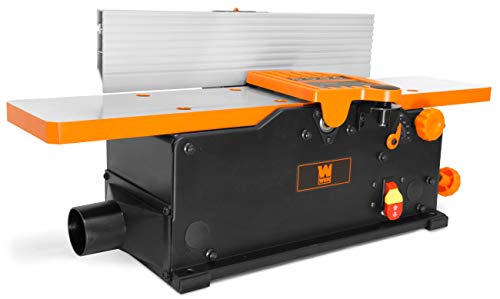
Check exact model, included equipment and current seller details.
Check AmazonDistinguish the shape of the problem
Bow runs along the length, cup across the width, and twist changes the relationship between corners. A board may contain more than one condition. Describe what you see before deciding how to process it. Use a straightedge and winding sticks on a stable inspection surface, away from the cutterhead. The purpose is not to attach a perfect label to the defect; it is to understand where material would need to disappear to create a reference.
Protect the required finished thickness
Measure the rough board and compare it with the finished part on your cutting list. A thick-looking blank can lose substantial usable thickness when distortion is corrected. Consider whether a shorter appropriate blank or different stock selection would preserve more material, while respecting every machine's minimum workpiece requirements. This planning is often more productive than adding another series of passes. Once you have removed the allowance, a flatter board may still be useless for the intended component.
Avoid flattening by force
Holding a flexible board forcibly flat can disguise its natural shape during an operation. When that force is removed, the shape may return. The goal is to establish a reference through an approved machining method, not to bend the board into temporary agreement with the table. Use your model's handling instructions and reject a piece you cannot control appropriately. Do not improvise shims or auxiliary fixtures around an exposed cutterhead based on a general explanation of wood movement.
Check the complete product offer
Affiliate link. Confirm the version, specifications and included accessories before purchase.
Check AmazonDecide whether the stock is suitable
Distortion is only one consideration. Check for unstable knots, splits, contamination and dimensions outside the manual's limits. Inspect reclaimed stock particularly carefully; age or attractive grain does not make it suitable machine stock. The Grizzly manual includes stock inspection as a separate operation-planning topic. Treat that separation seriously. If a board is unsuitable, changing the depth setting or upgrading to carbide inserts does not resolve the underlying problem.
Evaluate progress between operations
After an approved pass sequence, inspect the piece off the machine rather than relying only on the newly exposed color. A continuous fresh surface and a useful flat reference are related but not identical ideas. Recheck twist, straightness and remaining thickness. If progress stalls or the board behaves unpredictably, stop and reconsider the process. Do not make an increasingly aggressive cut solely because the part has already consumed time; that is a poor reason to sacrifice the remaining stock.
Choose the best use for the material
Compare the remaining usable dimensions with the cutting list before committing more time to a badly warped board. Shorter parts, another project or noncritical uses may preserve some value, provided the later processes suit the stock. Check minimum workpiece dimensions before dividing it into blanks. When waste, handling difficulty and uncertainty outweigh the value of the finished component, replacement stock is the practical choice. A jointer need not rescue this particular board to remain useful for the rest of the project.
Questions, answered
Will jointing remove twist?
It can establish a flat reference on suitable stock using an appropriate process, but the required material loss may exceed the board's allowance. Inspect the blank and follow the machine instructions.
Can I press a bowed board flat while cutting?
Do not use force to disguise the board's distortion or depart from the manual's handling method. A flexible board can return toward its original shape when pressure is removed.
Should every warped board be saved?
No. Consider remaining dimensions, defects, handling and the intended component. Selecting better stock can be a more reliable and economical decision.